process
-
test prints in PLA 01
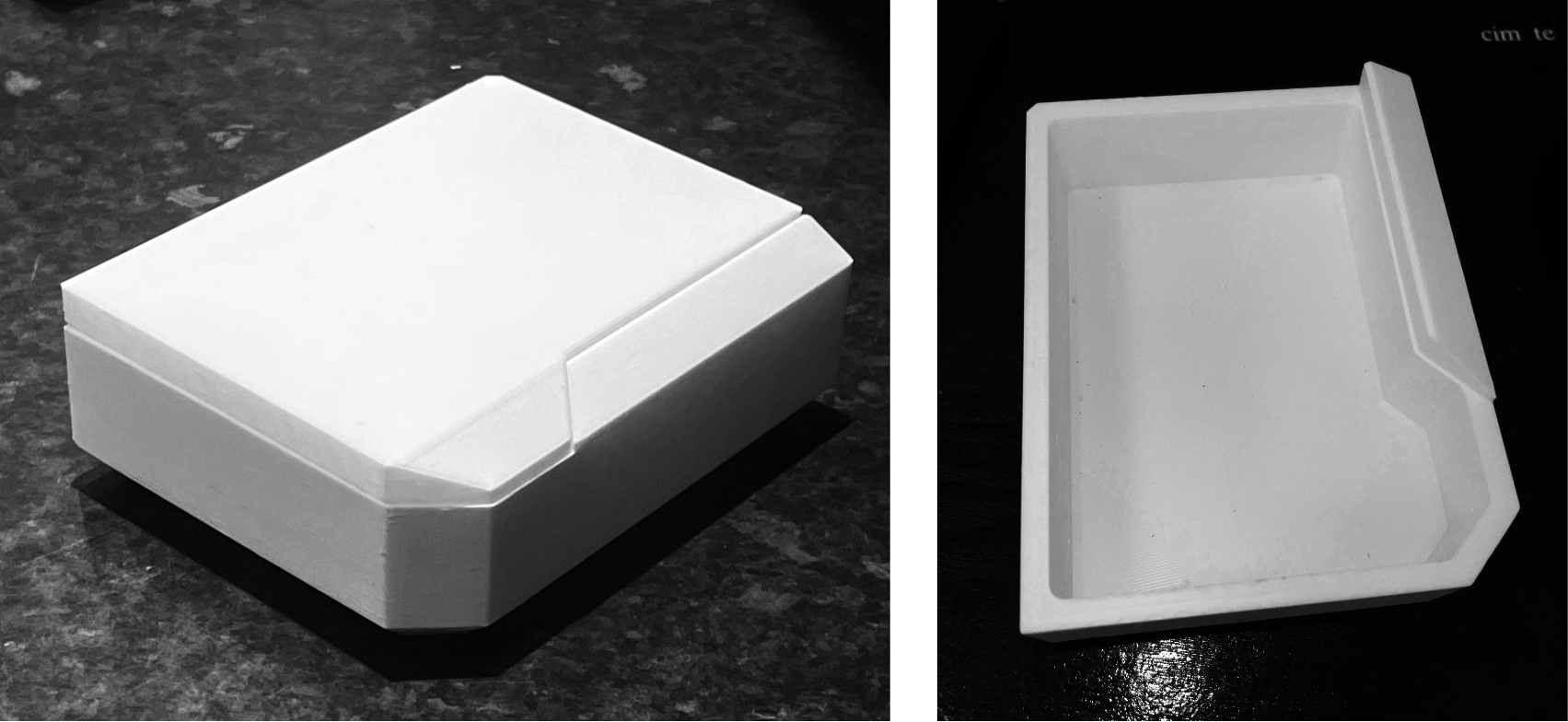
I printed early prototypes on a Bambu Lab P1S to check scale, footprint and the friction-fit lid, with foamboard standing in for the cork. The first body was square and failed on desirability, because it was too predictable. A 45-degree chamfer on the bottom edges fixed that and gave a shadow gap that makes the slab look as if it floats, but it left a compound angle on the front that a 3-axis machine could not mill. The second prototype kept the look and the toolpath, with edge breaks sized for R3.5 carbide end-mills.
-
richlite, richlite and annealed steel, richlite and cork 02
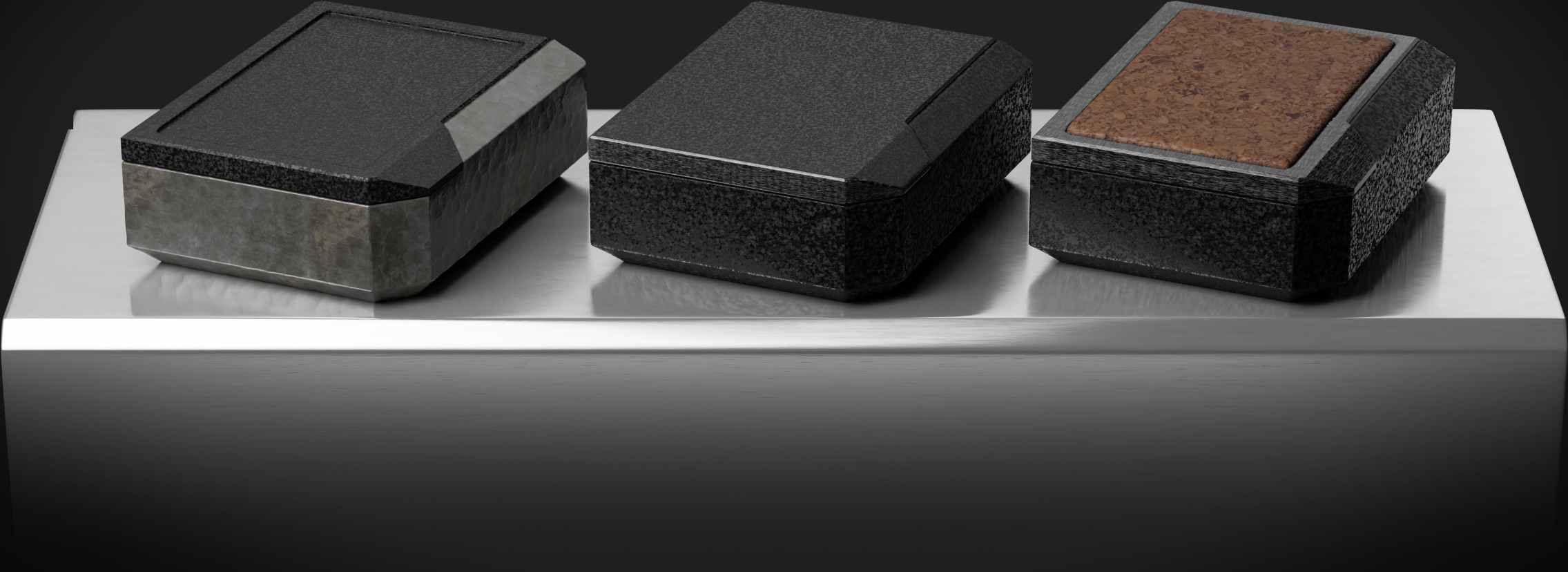
I compared Richlite, Paperstone, Valchromat, sapele, walnut, birch ply, Jesmonite and cedar on cost per box, machining, edge and FSC availability. Richlite is compressed paper that machines like hardwood and shows the strata Schofield likes, at about £40 a box. Jesmonite was out because it would repeat the Mausoleum. I also explored variants in cherry and bronze, recycled polymer, and aluminium and cork before settling on Richlite.
-
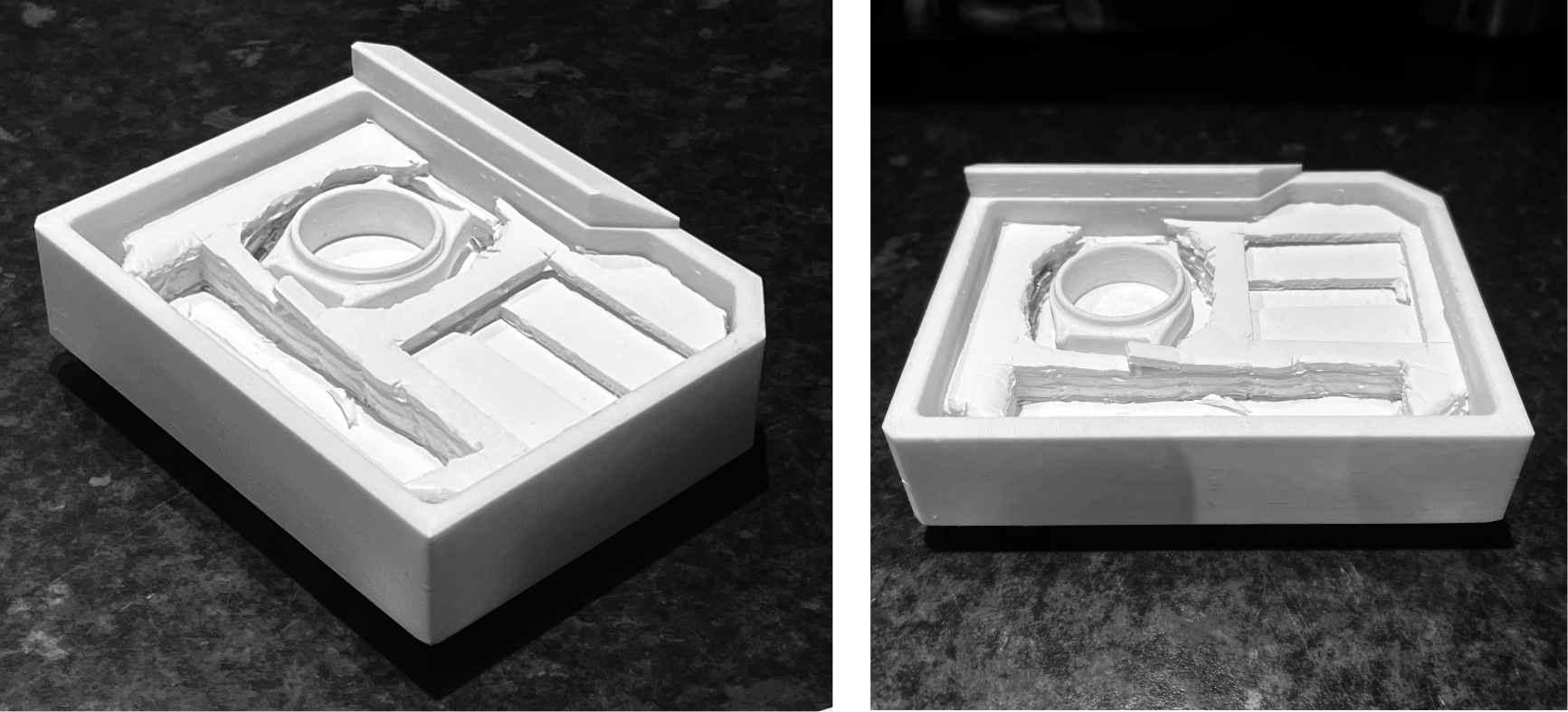
the insert, mocked up in foamboard 03
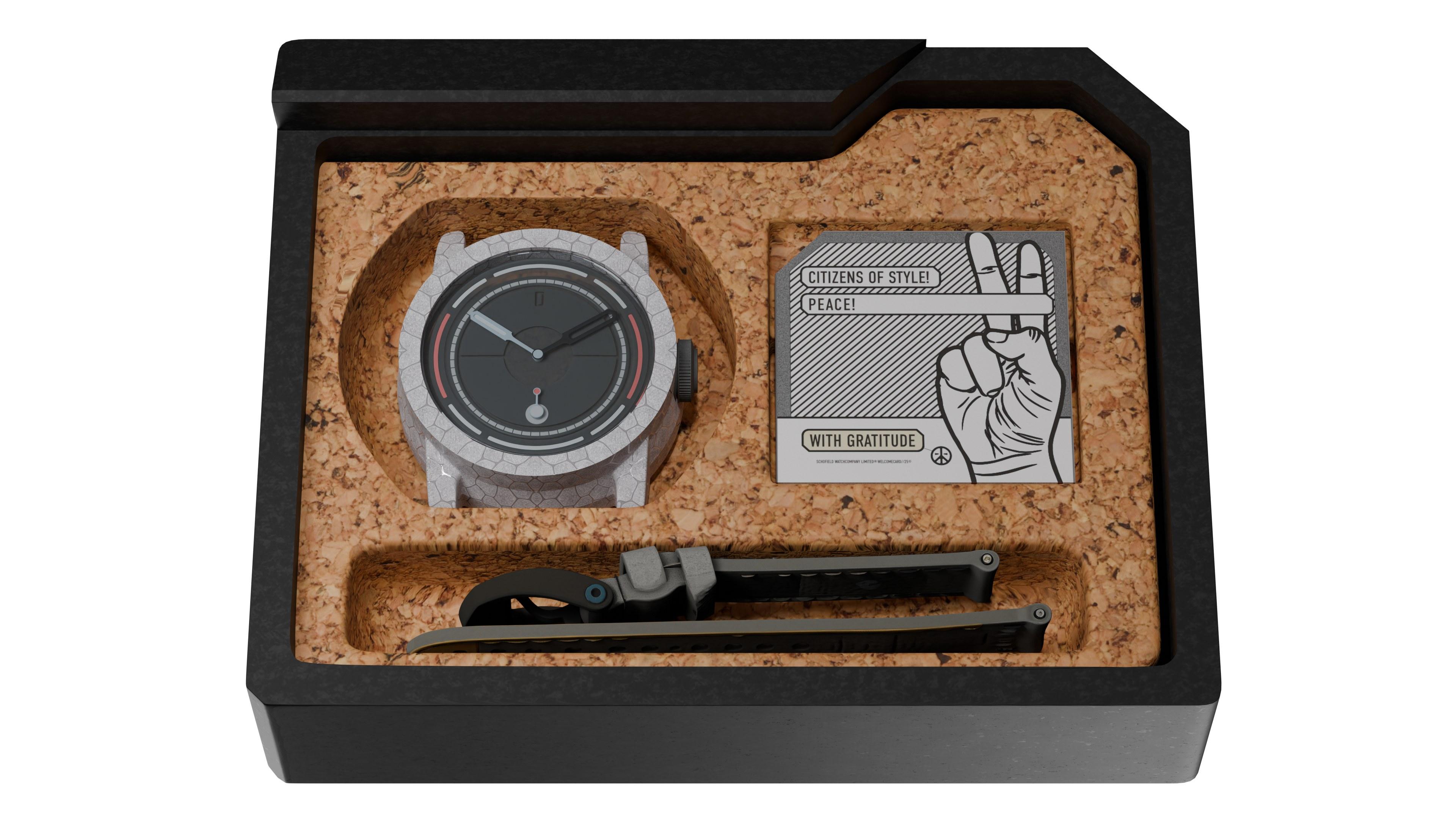
The watch ships in pieces, so the cork insert holds the head, the strap and the hardware, and the buyer has to lift the GF Smith papers to find the screwdriver beneath. That friction is deliberate, and it turns unboxing into a small task. The cork is routed to a friction fit with no adhesive, and once the watch is built the insert lifts out and the box becomes a permanent store.
the client
Schofield is Giles Ellis. He studio-manages, designs, writes the copy and takes the photographs, and describes the brand as “I am the filter”. He came to watches from the BBC’s wardrobe and special effects departments, and never trained as a watchmaker. After eighteen years of trading the brand has a single, undiluted taste: a desaturated palette taken from 1950s to 70s British Leyland paint, and objects that reward a slow look.
Schofield already has a watch box, which he calls the Universal Box, and a cast Jesmonite box called the Mausoleum. His test for a new one is whether it would still be coveted if found empty in an antique shop in fifty years. That rules out most of luxury packaging, and it means the box is for keeping, not for an unboxing video.
the brief
The box had to take the whole Schofield range without retooling. The models run from 40 mm to 44 mm across and from 13.5 mm to 15 mm high, so a cavity sized for the largest would leave a smaller watch with about 4 mm of play. It had to cost no more than £150 landed per unit at a run of 50, and the Curveball papers had to be carried inside the box, not around it. I treated that as an engineering problem first.
I worked backwards from what could be made: list the materials in the price band, list the processes a supplier can deliver at 50 units, ask every supplier the same three questions about minimum order, lead time and prototype cost, and only then start sketching. I checked every idea against desirability, feasibility and viability.
who opens it
Buyers range from the Pragmatist, who treats the watch as wrist-mounted brutalist architecture, to the Pipster, who reads the weekly Six Pips newsletter and forgives delays. They all treat the box as the first physical touchpoint of the brand, expect it to reveal itself slowly, and want a postal box that protects it.
I studied unboxing as a designed sequence. Kahneman’s peak-end rule says people judge an experience by its peak and its end, so the design weight goes to the reveal of the box and to the discovery of the papers. Anticipation is part of the pleasure, so friction is a feature. A good box engages at least four senses, including weight and sound.
the system
The package has three layers. The watch box is the object kept on a shelf, the second box is the reveal, and the postal box is made to be thrown away, in single-material corrugated that fits a Royal Mail small parcel under 1.5 kg. Visual richness escalates inward.
There is no plastic or foam anywhere. Every sustainability claim traces to a supplier certificate, the adhesive is a low-outgassing epoxy so it cannot fog the sapphire crystal, and a serial and batch number is engraved on the base for traceability.
three concepts
The first drew on the Eddystone Lighthouse, marine chronometers and a landmine, with a Fresnel lens lid over a gimballed watch. It failed on all three of desirability, feasibility and viability. The second combined the Monument to the Revolution with a Stevenson screen, cast in Jesmonite. It passed, but the heavy tiered slab looked too much like the Mausoleum, so I closed it.
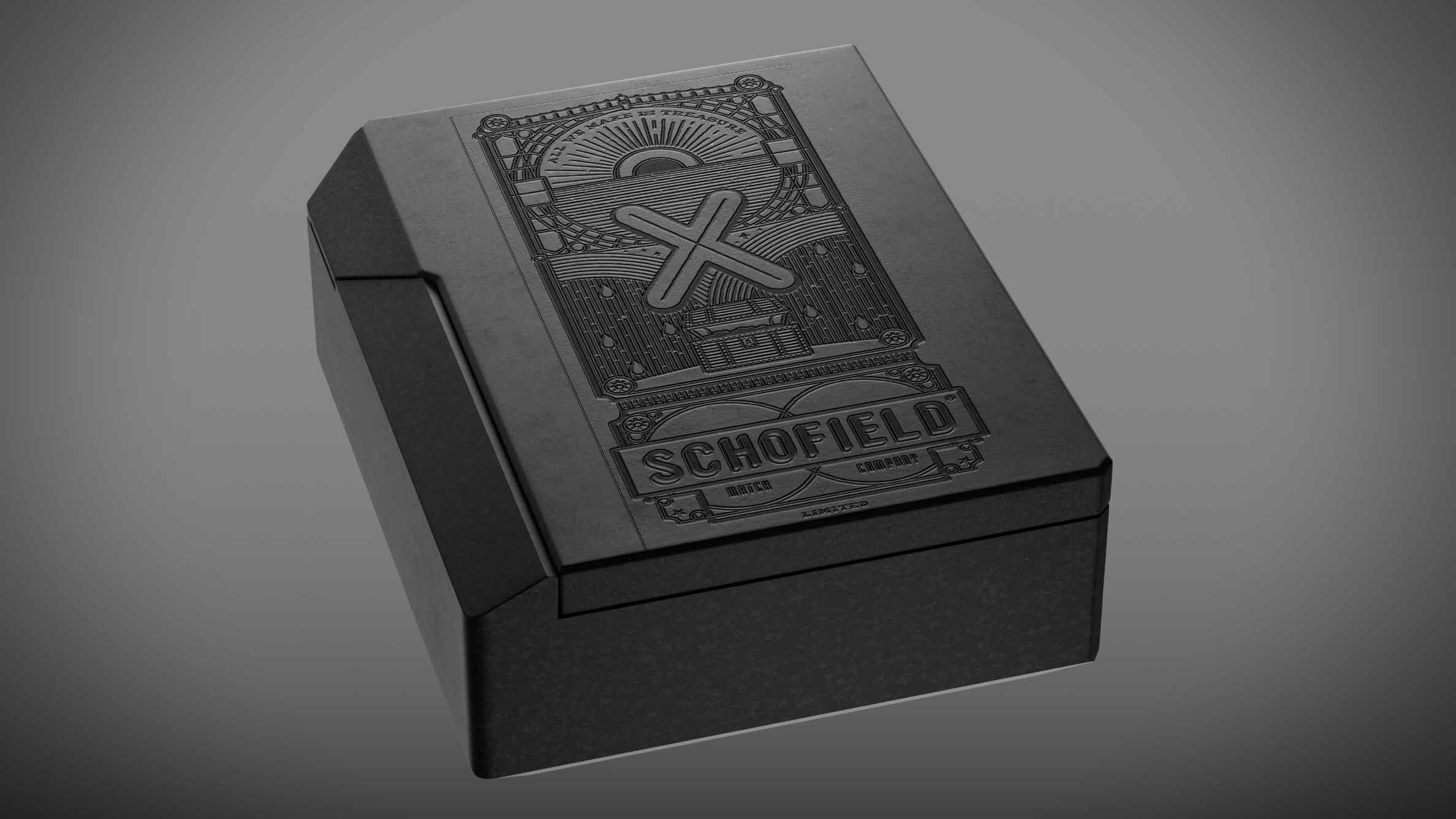
The third, The Record, is a monolithic slab inspired by a manila folder. It is cut on one 3-axis setup, and it replaces a fragile hinge with a friction-fit lid, which forces a deliberate lifting gesture. Its weight and precision should still make it worth keeping if it were found empty decades later.
the papers
The Care, Warranty and Welcome papers are tabbed index cards in 270 gsm dark grey card, to suit the folder idea. I redesigned the layout and left Giles’s words alone, because his voice is the brand. A line like “NOT DROPPING IT AT ALL IS BEST” would lose its charm if it were made generic.
the cost
The bill of materials comes to a landed cost of £85.55, which leaves a 43% margin under the £150 ceiling. The largest line is the CNC work at about £28 a unit, with hand finishing at about £10. The papers come from GF Smith, which does not print or foil, so the printing and white foil are a separate specialist job.
references
ASTM International (2021) ASTM E595-15(2021) Standard test method for total mass loss and collected volatile condensable materials from outgassing in a vacuum environment. West Conshohocken, PA: ASTM International.
Ellis, G. (2021) Schofield brand values and community. Internal document, Schofield Watch Company.
Forest Stewardship Council (2021) FSC-STD-40-004 V3-1 Chain of custody certification. Bonn: FSC International.
Great British Life (2024) The Sussex watchmaker. Available at: https://www.greatbritishlife.co.uk (Accessed: 10 April 2026).
Kahneman, D. (2011) Thinking, fast and slow. New York: Farrar, Straus and Giroux.
Loewenstein, G. (1987) ‘Anticipation and the valuation of delayed consumption’, The Economic Journal, 97(387), pp. 666-684.
Norman, D.A. (2004) Emotional design: why we love (or hate) everyday things. New York: Basic Books.
Oracle of Time (2026) Interview with Giles Ellis of Schofield. Available at: https://oracleoftime.com (Accessed: 10 April 2026).