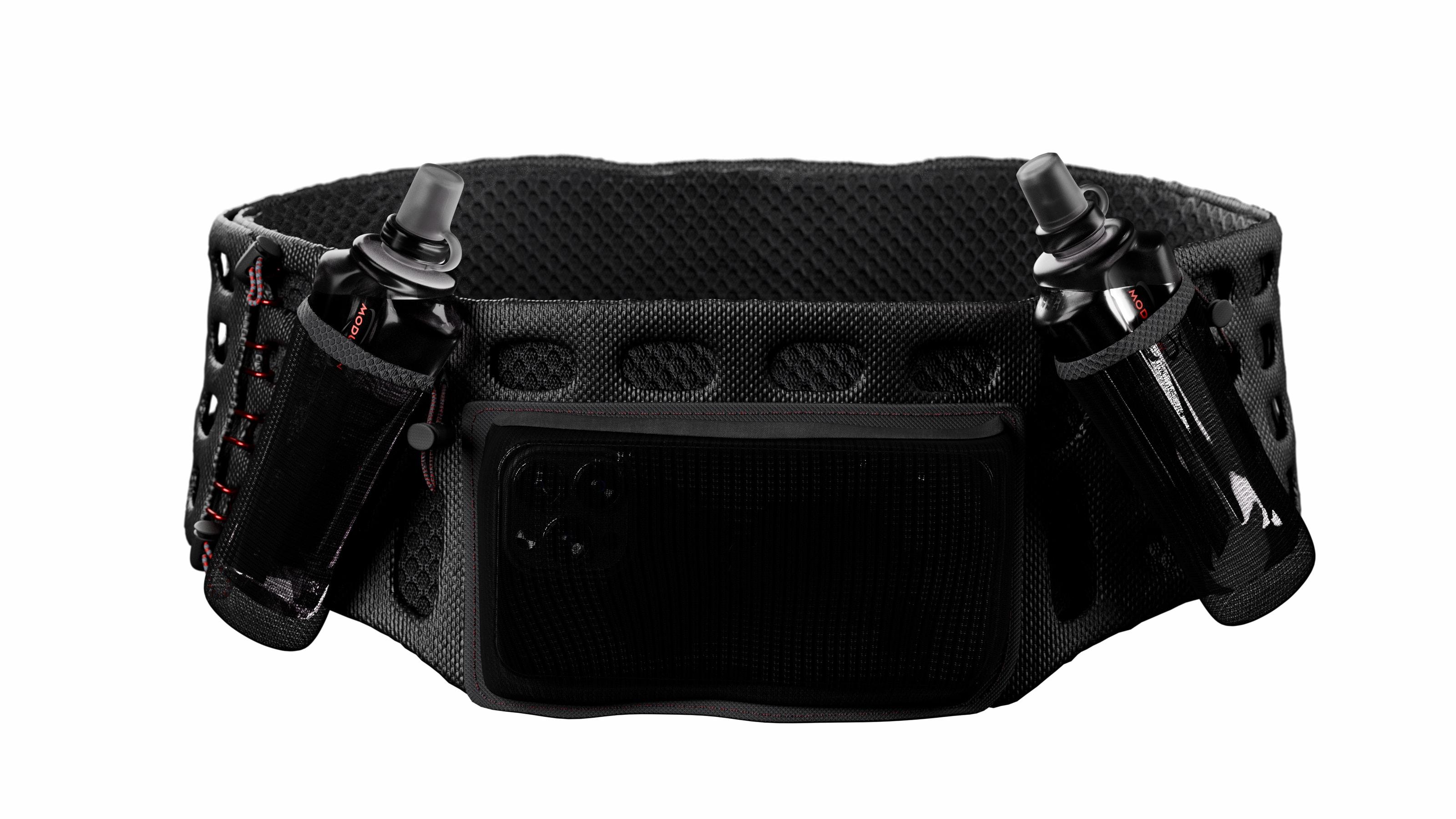
process
-
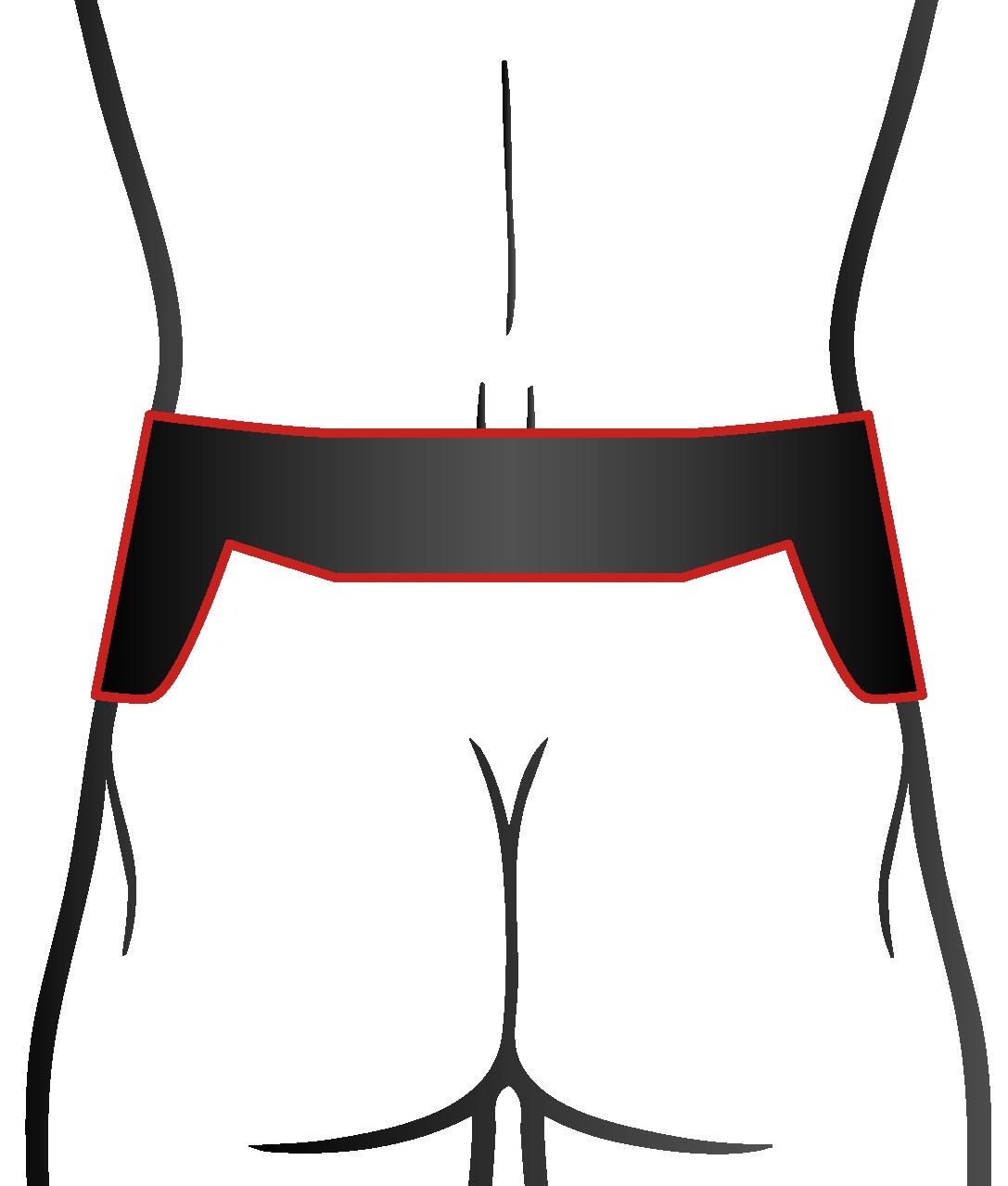
the final form, tapered to the hip bones 01
The first form had a deep front panel to lower the centre of mass, but it limited leg movement. The second had flared hip extensions to pad the bottles, and was too bulky for the arm swing. The final form is a minimal band with a subtle taper that matches the iliac crest, which gives load stability without getting in the stride.
-
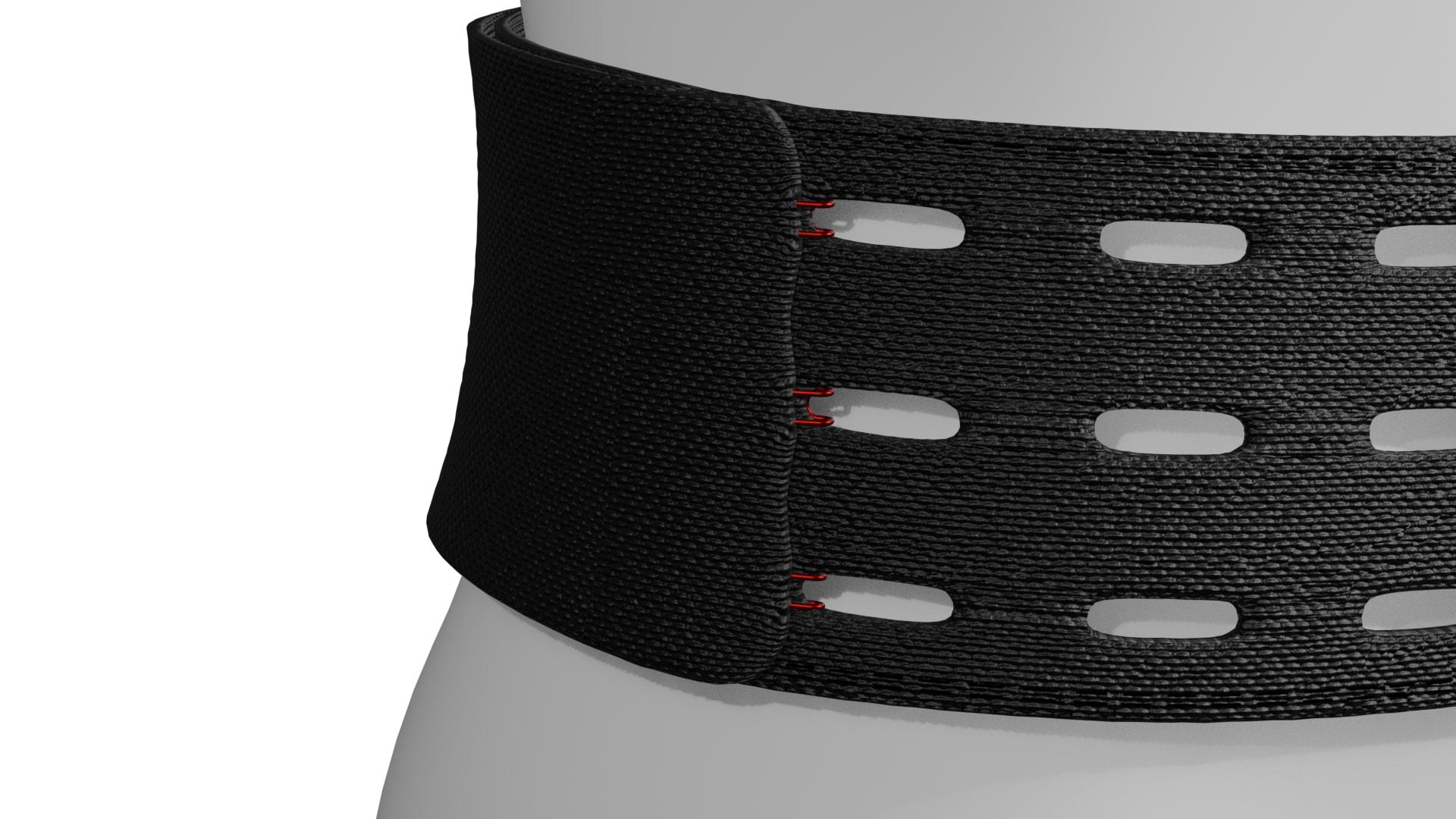
elongated slots hold the pockets in place 02
The attachment points began as circular cut-outs, which let the pockets twist and bounce. Elongated horizontal slots locked them in place. The first closure, a hook and eye, could not make micro-adjustments mid-run, so dual elastic shock-cord adjusters along the top and bottom edges let you dial in tension as you go.
-
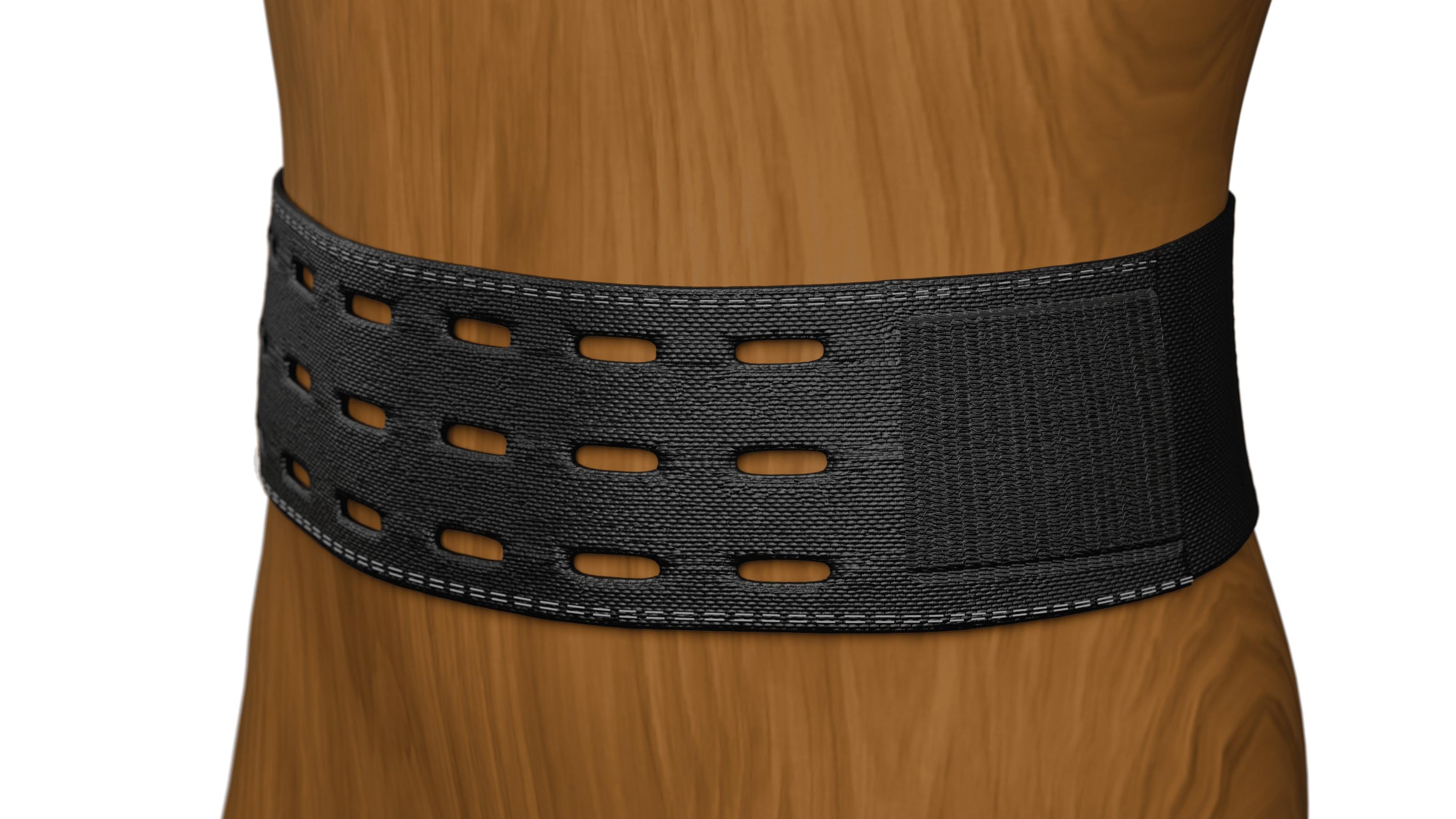
slots for the modules, a Velcro panel for patches 03
Runners choose their own modules. Pockets have a back strap that interlocks with the slots, so they can sit anywhere along the belt. A Velcro panel carries patches and race numbers, so no two belts look the same.
-
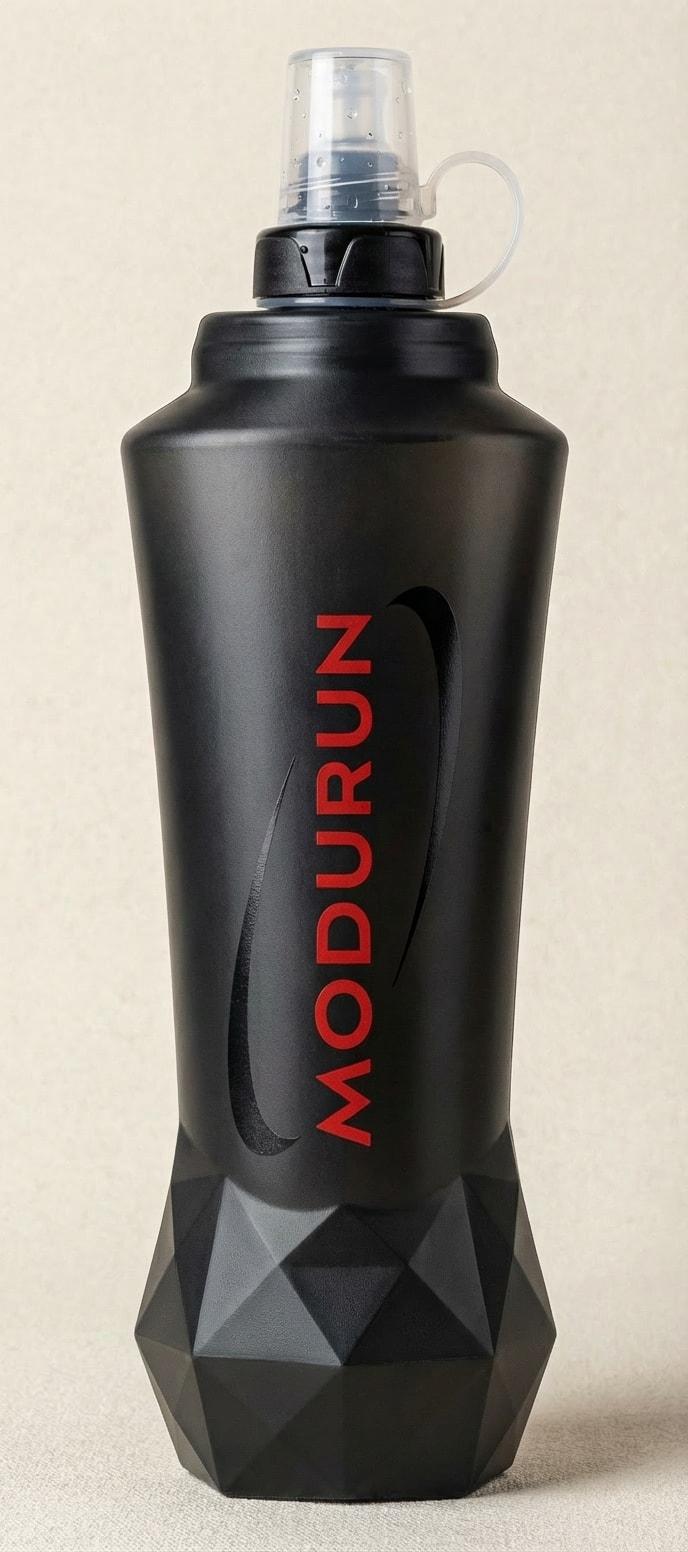
a flask with a geometric base 04
Water sloshing in a long bottle builds speed before it hits the wall, so a longer bottle tugs harder on the belt. Splitting the length with baffles, as oil tankers do, raises the sloshing frequency and cuts the force. The pocket geometry was also redone after the group presentation, because the first holsters did not fully enclose the flasks.
Modurun is a group project from H7008 Design for Industry, made with Nolan Ford and Ethan Charalambous. The brief asked for a physical product and a complete start-up brand to take it to market, with a 30 to 60 second promotional video.
the brief
Runs of 10 to 30 km fall between two products: the hydration vest, which is over-engineered for the distance, and the belt, which fails beyond 10 km. The brief listed seven failure modes in competing belts: rotational slipping, upward creep, bounce, sweat saturation, inaccessible storage, poor adjustability and a mediocre look. It also set eight criteria: stability, accessibility, capacity for two 500 ml flasks, durability, breathability, adjustability, aesthetics and sustainability.
research
We combined an online survey with observation in sport shops, a competitor audit and secondary research on fabrics, biomechanics and slosh. The audit covered the Compressport Free Belt Pro, the Ronhill 360 Waistband, the Naked Running Band and the Satisfy Running Belt, which fail in different ways: bounce with two flasks, slipping past 10 km, twelve fixed sizes, and style over utility.
In the survey, 92% of runners carry a phone and 60% carry keys, and 75% use their shorts pockets. The persona was Alex Mercer, 29, a junior engineer in Brighton who runs two or three times a week and wants a high-friction fit, a big phone pocket, separate key storage and micro-adjustment.
why belts fail
When the load’s kinetic energy exceeds the elastic’s modulus, the belt can no longer hold tension. It rides up the iliac crest to the narrowest part of the torso, loses tension and bounces. A flat, symmetrical profile also rotates around the waist. In the audit we saw three more failures: holster pockets at awkward angles, bottle corners biting into skin, and stitched seams ripping once the fabric was saturated with sweat.
the materials
Each failure got a material answer. The shell is a PA6 and elastane interlock with auxetic-knit panels, which keep their shape. TPU-bonded and ultrasonic seams remove the thread that abrades wet skin. The lining is a modified cross-section fibre with a zeolite antimicrobial treatment, and the zips are YKK Vislon POM, which resists salt and heat. Fabrics are to be OEKO-TEX and REACH compliant.
the modular system
Runners choose their own modules. Pockets have a back strap that interlocks with the slots, so they can sit anywhere along the belt. Four modules ship with the base belt, including a front phone pocket and a side soft-flask holster, and more attach for longer runs. A Velcro panel carries patches and race numbers, so no two belts look the same.
making it
The belt would be made in vertically integrated knitwear factories in Bangladesh or Vietnam for low cost, or in Portugal for a premium line, with minimum orders of 500 to 5,000. The landed cost is about £17 at a 5,000 run, against a retail price of £40 to £60. The largest costs are cut-make-trim labour at £3.78, the lining at £2.65 and the two zips at £2.27.
the brand
The name is “modular” plus “run”, and the modular promise is the proposition. The mark is an orbital swoosh in red and black set in Orbitron, with the line “Run with everything”. The palette is black, off-white and a bold red.
The project’s curveball was to use the name “Steady” and a supplied logo. The original was a single forest green, a colour that suggests slowness and nature and is calm when an athletic brand needs energy, and its tortoise leaned back almost apologetically. We redrew it in black and terracotta red, tilted it forward with the arcs pointing the same way, and paired it with “Built for the long run”, which draws on the fable of the tortoise that wins by persistence.
getting it to market
The campaign uses Instagram posters and stories, live race events where the top finishers win a belt or extra modules, and a “Run More Miles” scheme that gives runners points for distance to spend in the store. The portfolio also includes the packaging, the branded shirts and tags, and a working website written in HTML.
references
Baggaley, M., Esposito, M., Xu, C., Unnikrishnan, G., Reifman, J. and Edwards, W.B. (2020) ‘Effects of load carriage on biomechanical variables associated with tibial stress fractures in running’, Gait & Posture, 77, pp. 190-194. Available at: https://doi.org/10.1016/j.gaitpost.2020.01.009 (Accessed: 4 March 2026).
Baxter, N. (2025) Running Experience Survey Report 2025. Running Studies. Available at: https://runningstudies.co.uk/running-experience-survey-2025 (Accessed: 13 March 2026).
Naked Sports Innovations (no date) Naked running band. Available at: https://nakedsportsinnovations.com/products/naked-running-band (Accessed: 9 March 2026).
Niromi, S., Sachie, G. and Farhana, J. (2015) ‘A comparison between bonding and sewing: application in sports performance wear’, Journal of Asian and International Research, 1(1), pp. 1-8.