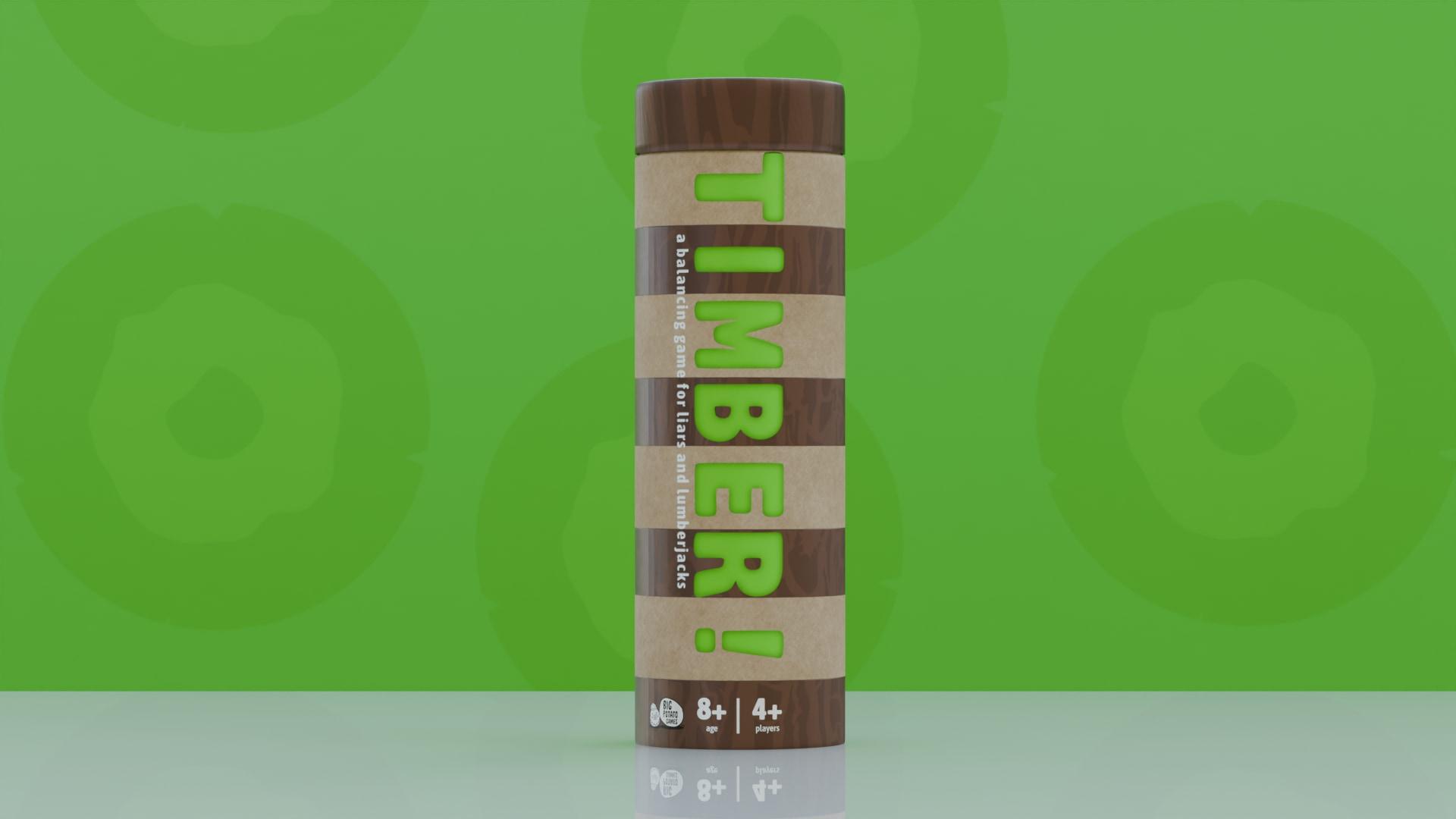
process
-
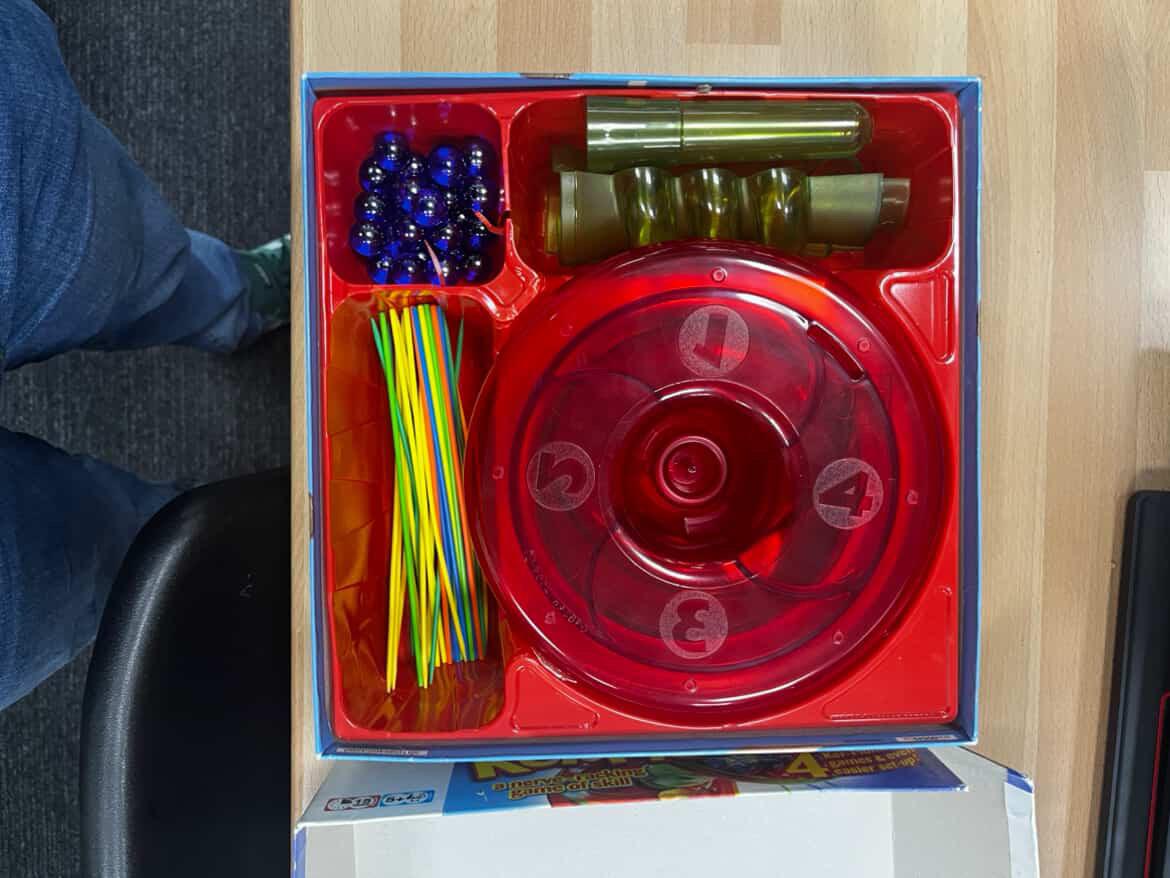
taking games apart: kerplunk, muffin time, risk 01
I took apart Big Potato's games and five dexterity games, and found that the dexterity games all end on a visible collapse. Kerplunk has a gravity penalty that needs no language at all. My first idea, throwing blocks into a pile, already existed as Steps. I kept the gravity and changed what leads up to it, from speed to slow bluffing.
-
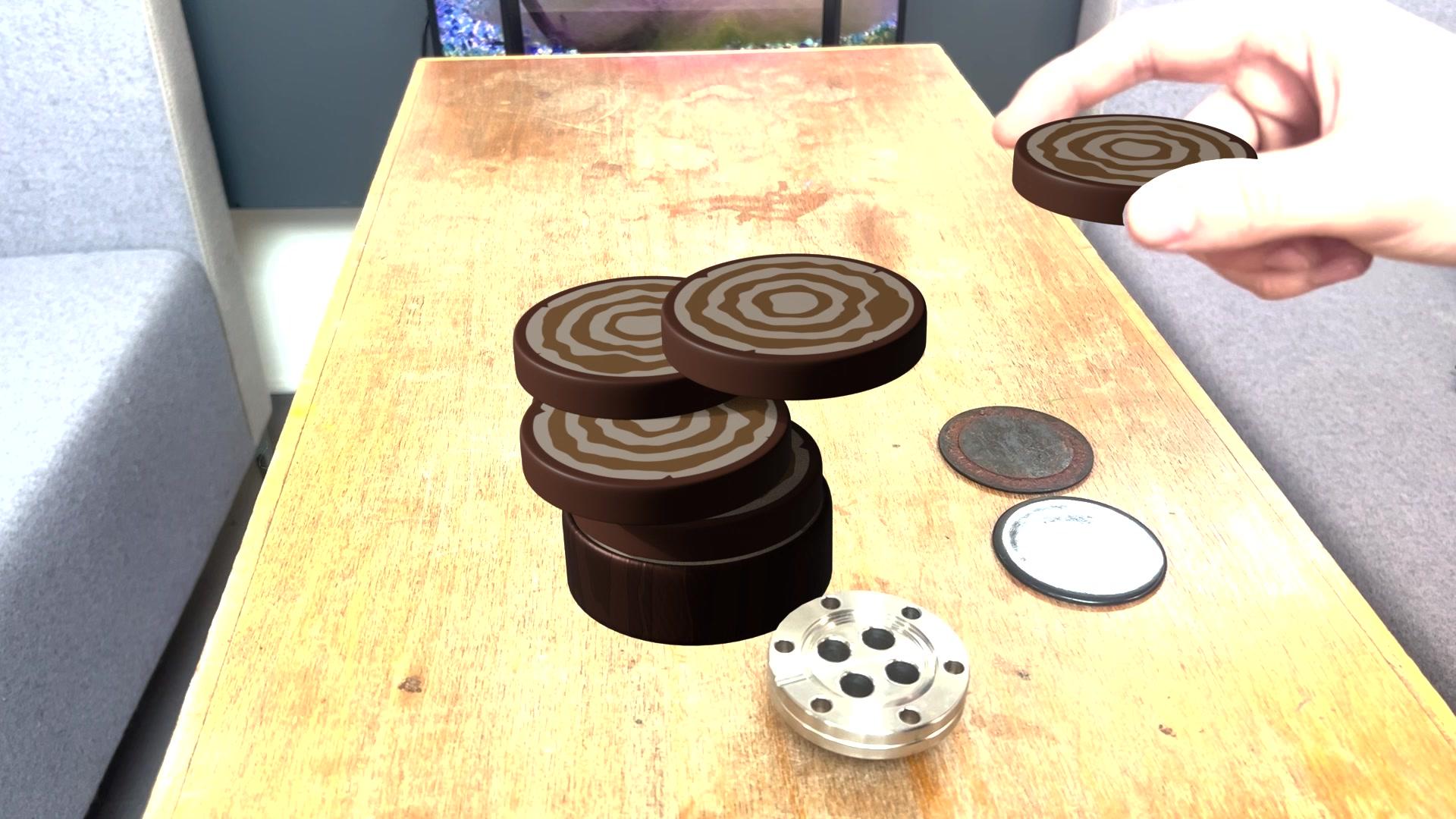
the hidden weight, shown in the sizzle 02
Each disk hides a steel slug off-centre, with a notch on the edge to find the heavy side by touch. Early PLA builds slid apart, so I locked the numbers in Blender's rigid body physics, with a static friction of 0.6 and a disk-to-slug mass ratio of 6:7. A hole through the middle made players build outward, but a tyre look was wrong for a party game, so I filled it in as a log cross-section. The tree rings now show where to place the next piece.
-
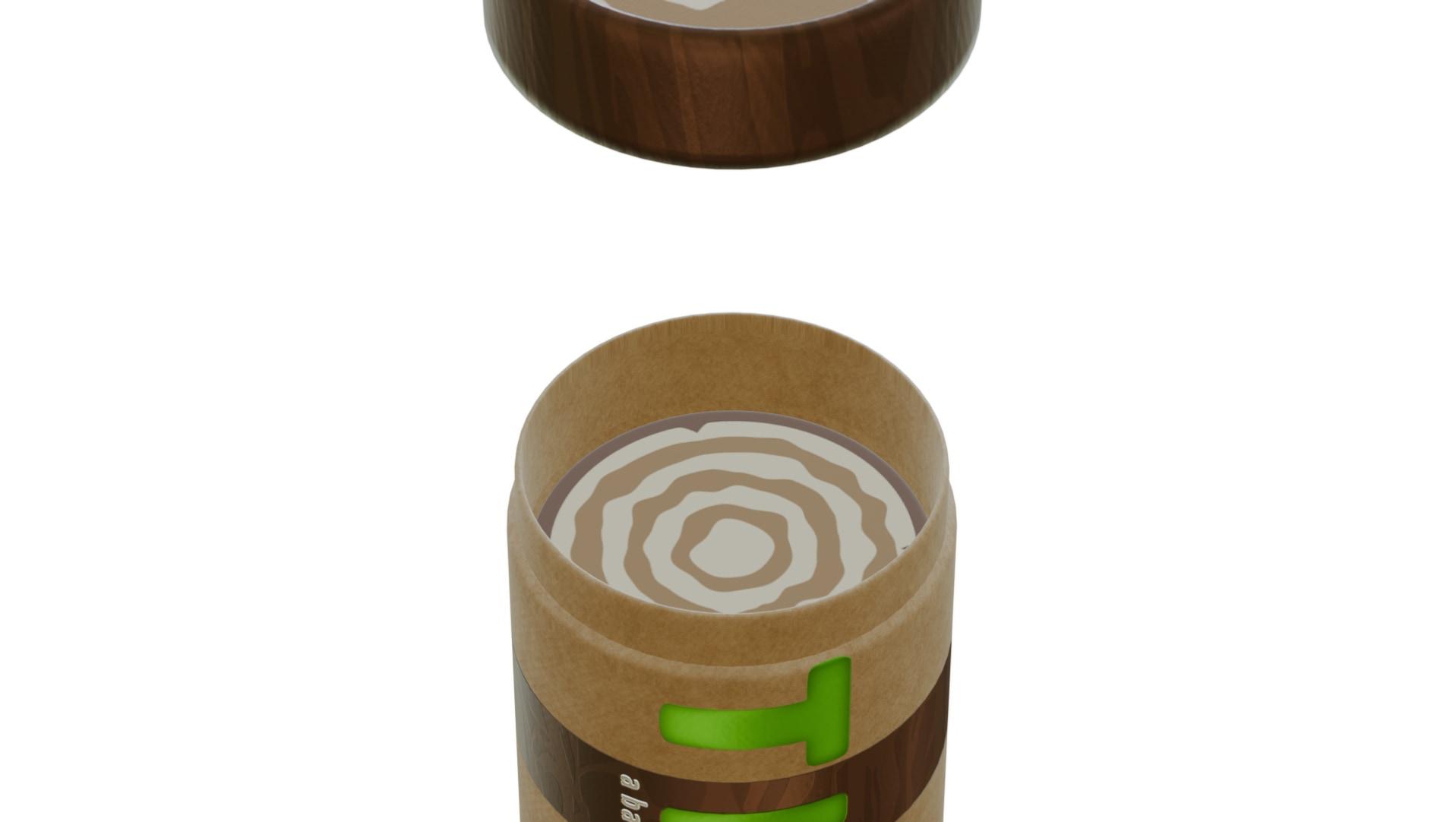
the lid is the stump 03
A leaning box cost too much to tool and wasted shipping volume, so the game ships in a cylindrical kraft tube. Its lid is the starting stump, so the packaging becomes part of the game and a component drops out of the budget.
the brief
Big Potato Games, whose titles sit on shelves in 36 countries, asked for a globally viable, centrepiece-led party game. It had four rules:
- Keep it fast: under five minutes to learn and under thirty to play.
- Zero downtime: nobody sits out, everyone is engaged all the time.
- A spectator sport: as much fun to watch as to play, and made for short social video.
- Fresh themes: no fantasy and no mythical creatures.
It also had to sell internationally, so it could not depend on language, and it could not have drinking rules. I interviewed James, a senior game designer at Big Potato, on 22 April, and built three personas from that and from watching a game café: a parent hosting family nights, a non-gamer who finds long rulebooks like homework, and a pub regular who wants something new for the bag.
how I read a game
I used the MDA framework (Hunicke, LeBlanc and Zubek, 2004), which splits a game into mechanics, dynamics and aesthetics. Mechanics are the rules and components, dynamics are what happens between players, and aesthetics are the feelings people take home. You cannot design a dynamic directly, only promote it through the mechanics.
Taking apart Big Potato’s best sellers gave five mechanics: time constraints, asymmetric information, tactile components, voting and bidding, and constrained communication. What they share is one sharp moment of truth, a vote, a buzzer or a collapse. That reveal is what people remember and share.
where the gap was
I compared five dexterity games: Jenga, Suspend, Tokyo Highway, Bausack and Junk Art. All of them end on a visible collapse, and the failure, not the win, is what spectators remember. Four of the five build upward against gravity, and none of them makes players read each other. That left two openings: a new geometry, and a bluff on top of the dexterity.
three concepts
Squawk! was a card game of public commands and hidden traps. Concept 2 grew a vine across a grid with tiles, so every early loss became a wall late in the game. Concept 3, Panic Pile, removed turns entirely by having players throw light blocks into a central pile. Research showed Panic Pile already existed in the indie game Steps, so I dropped it and kept its best part, the gravity penalty. TIMBER! is that penalty with a new lead-up.
how it plays
Players take turns growing a tree from solid wooden disks, each weighted off-centre. You bluff by aiming the heavy side into thin air, and you place your disk so it covers the ring below. If the structure snaps you adopt the wreckage, unless you shout “TIMBER!” before the first disk hits the table, which passes the penalty to the player before you. It plays in under 30 minutes with four or more players aged eight and up, with no rulebook and a five-minute onboarding.
testing and the physics
The first tests showed two flaws. With no placement rules, players chose the safest move and built a dull vertical tower. And nobody could find the hidden weight before their turn. The notch fixed the second. The central hole fixed the first, because you had to see the table through the top disk, which pushed the tower outward, and hollowing the disk let me concentrate the mass on one edge for aggressive overhangs.
PLA was too slippery and milling wooden prototypes was out of budget, so I validated the design in Blender. The wood and steel were separate rigid bodies, which gave the centre of mass, a static friction of 0.6 to stop the disks sliding, and a 6:7 disk-to-slug ratio for the tipping point.
safety and ergonomics
The game is designed to meet BS EN 71-1 for mechanical and physical safety, BS EN 71-3 for chemical migration, and CE and UKCA marking, with BPA-free materials and FSC beech. Any hand-held part should clear a 60 to 95 mm grip span, from the 5th percentile 8-year-old’s hand breadth of 61 mm to the 95th percentile adult male’s 96 mm, so each disk is 85 mm across. A pinch needs at least 50 mm of clearance, and a component should weigh no more than 60 to 80 g to feel premium, so a disk is about 75 g with a 35 g steel slug. At 85 mm it is also well outside the choking-hazard cylinder.
making it, and the cost
The disks are FSC beech with a steel slug pressed in and sealed with a wooden plug. Milling each one would break the budget, so they are turned and parted on an automated lathe, which cuts the machining to about six pence. They are then tumbled in barrels with a silica-infused matte varnish, which sets the 0.6 friction with no hand finishing, and pad-printed.
That brings the factory cost to about £0.17 a disk, £3.06 for all 18, against a component budget of £4.90 at a first run of 10,000. The retail price is £20, with about £12 going to the retailer and £8.50 to the publisher.
sustainability
The set has no plastic. It is FSC beech, a recycled kraft tube and soy inks, and the disks are compostable. I also proposed one tree planted for every game sold, by routing about £0.34 of the factory cost to verified planting partners such as the Arbor Day Foundation, built into the bill of materials so the retail price does not change.
references
Big Potato Games (2026) Interview with James, senior game designer, Big Potato Games, 22 April.
British Standards Institution (2018) BS EN 71-1:2014+A1:2018 Safety of toys. Part 1: Mechanical and physical properties. London: BSI.
British Standards Institution (2019) BS EN 71-3:2019 Safety of toys. Part 3: Migration of certain elements. London: BSI.
Hunicke, R., LeBlanc, M. and Zubek, R. (2004) ‘MDA: a formal approach to game design and game research’, Proceedings of the AAAI Workshop on Challenges in Game AI. San Jose, CA, 25-26 July. Menlo Park, CA: AAAI Press, pp. 1-5.
International Organization for Standardization (2017) ISO 7250-1:2017 Basic human body measurements for technological design. Part 1. Geneva: ISO.
Open Design Lab (2024) ANSUR II anthropometric data. Available at: https://www.openlab.psu.edu/ansur2/ (Accessed: 24 May 2026).
Tabletop Games Blog (2025) Sustainability trends in the tabletop industry. Available at: https://www.tabletopgamesblog.com (Accessed: 24 May 2026).
Tilley, A.R. (2002) The measure of man and woman: human factors in design. Rev. edn. New York: John Wiley & Sons.