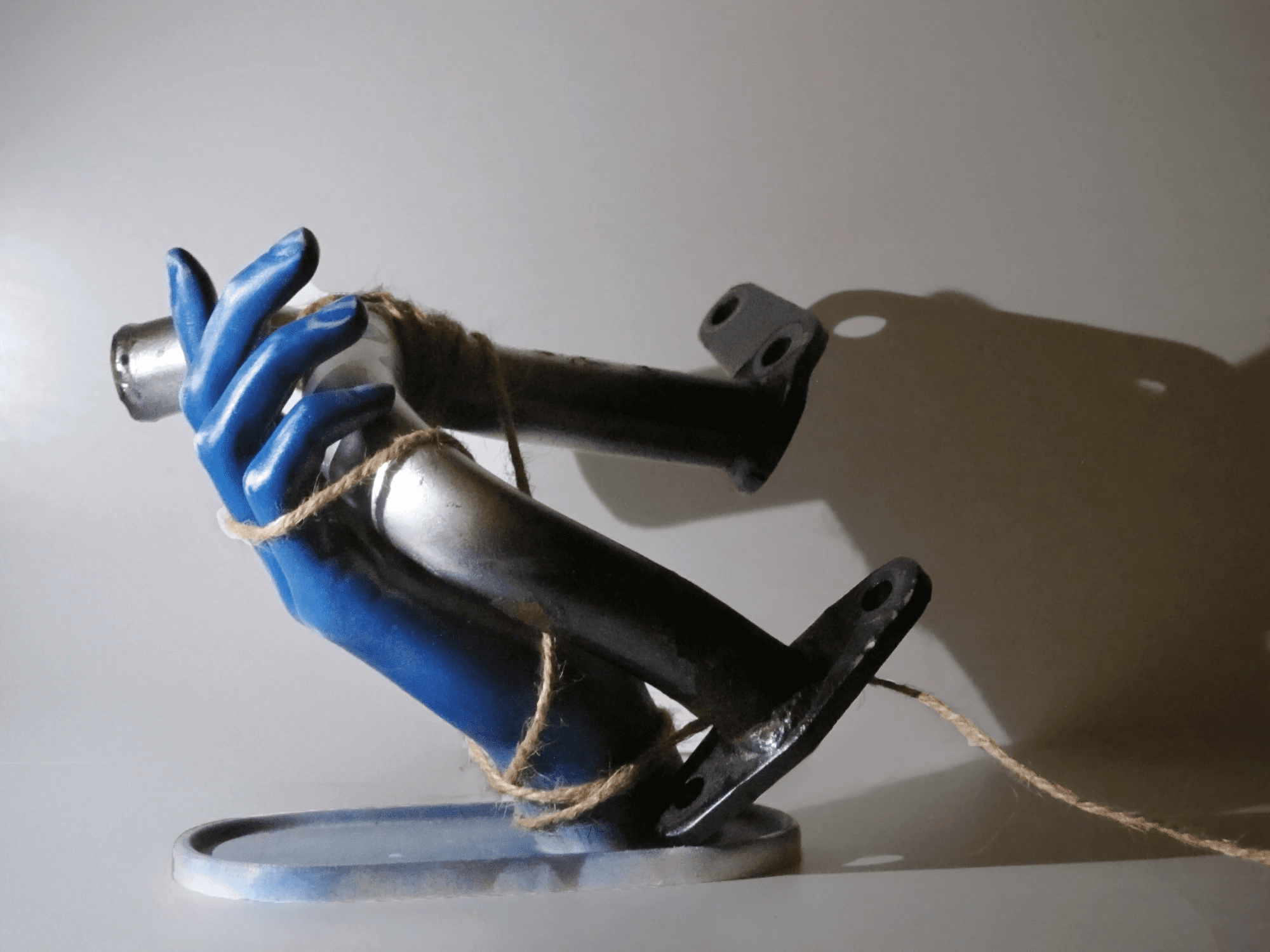
process
-
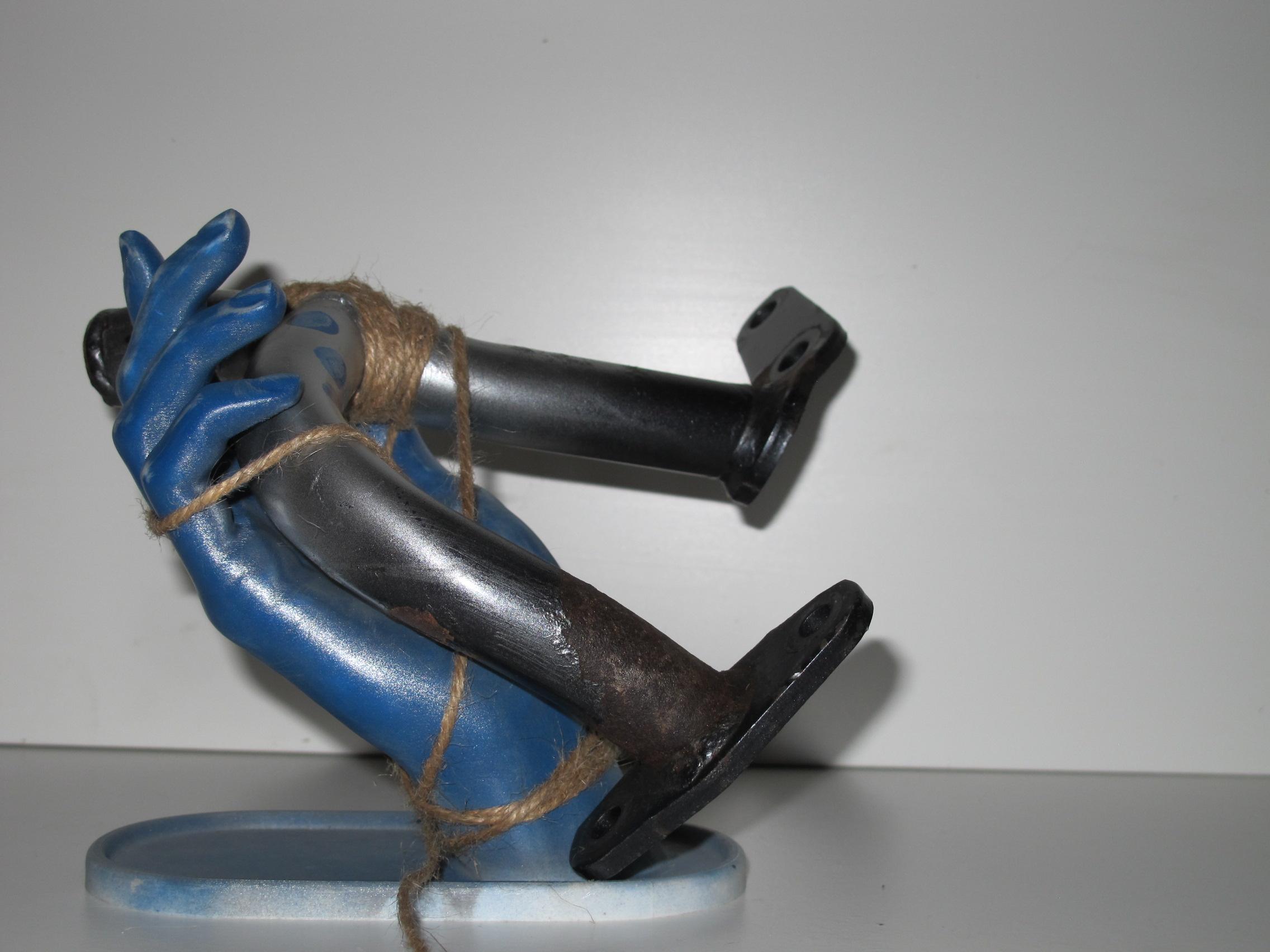
rust, where out of reach 01
Elsewhere the bar fades to black, then rust. What isn't personal to us gets neglected, and in time rusts away.
-
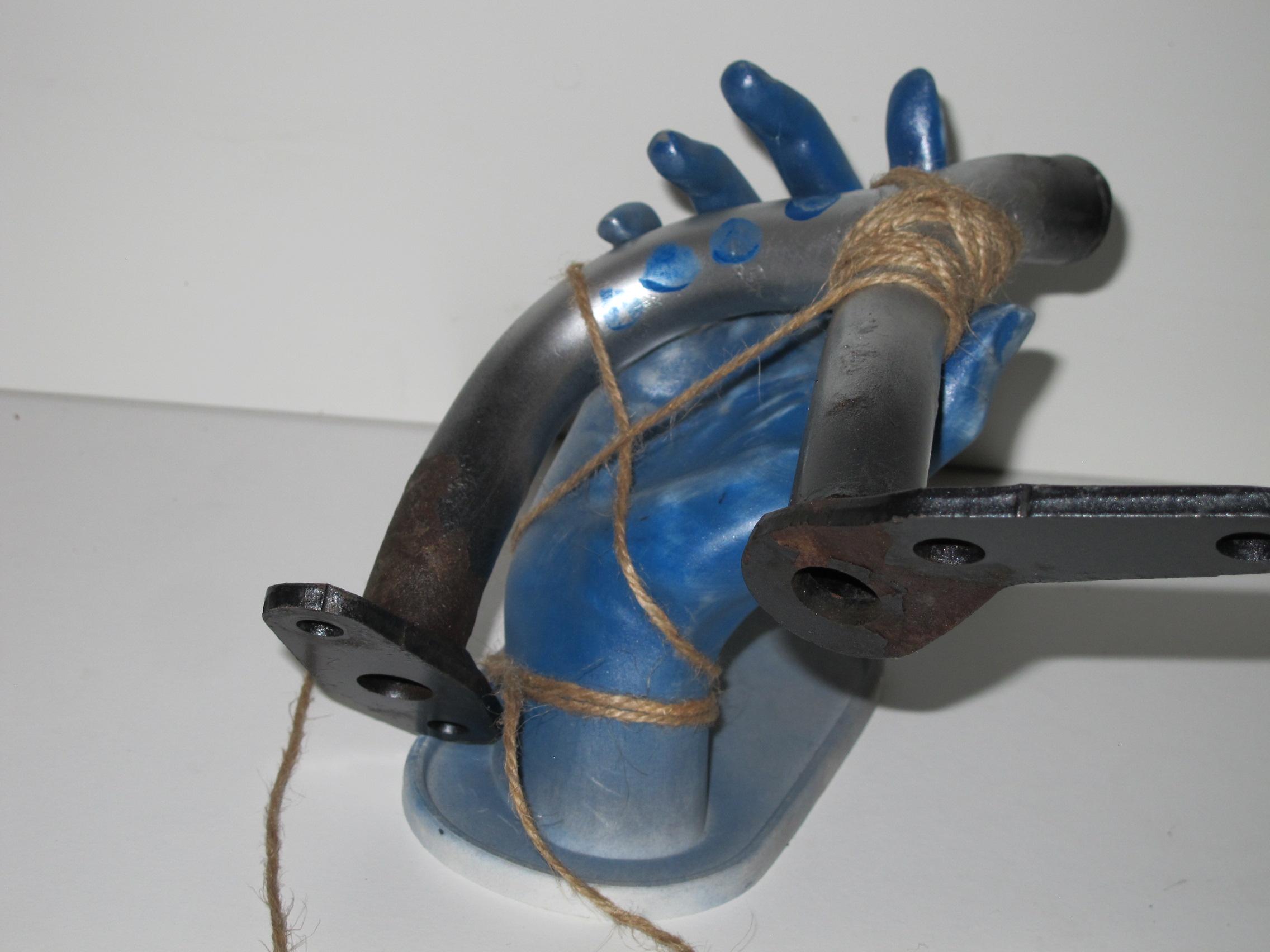
fingerprints, in the hand's blue 02
Where it is held, the bar is sprayed silver, renewed by care. Blue is not a skin colour, so the hand carries personality rather than likeness, left in fingerprints on the metal.
-
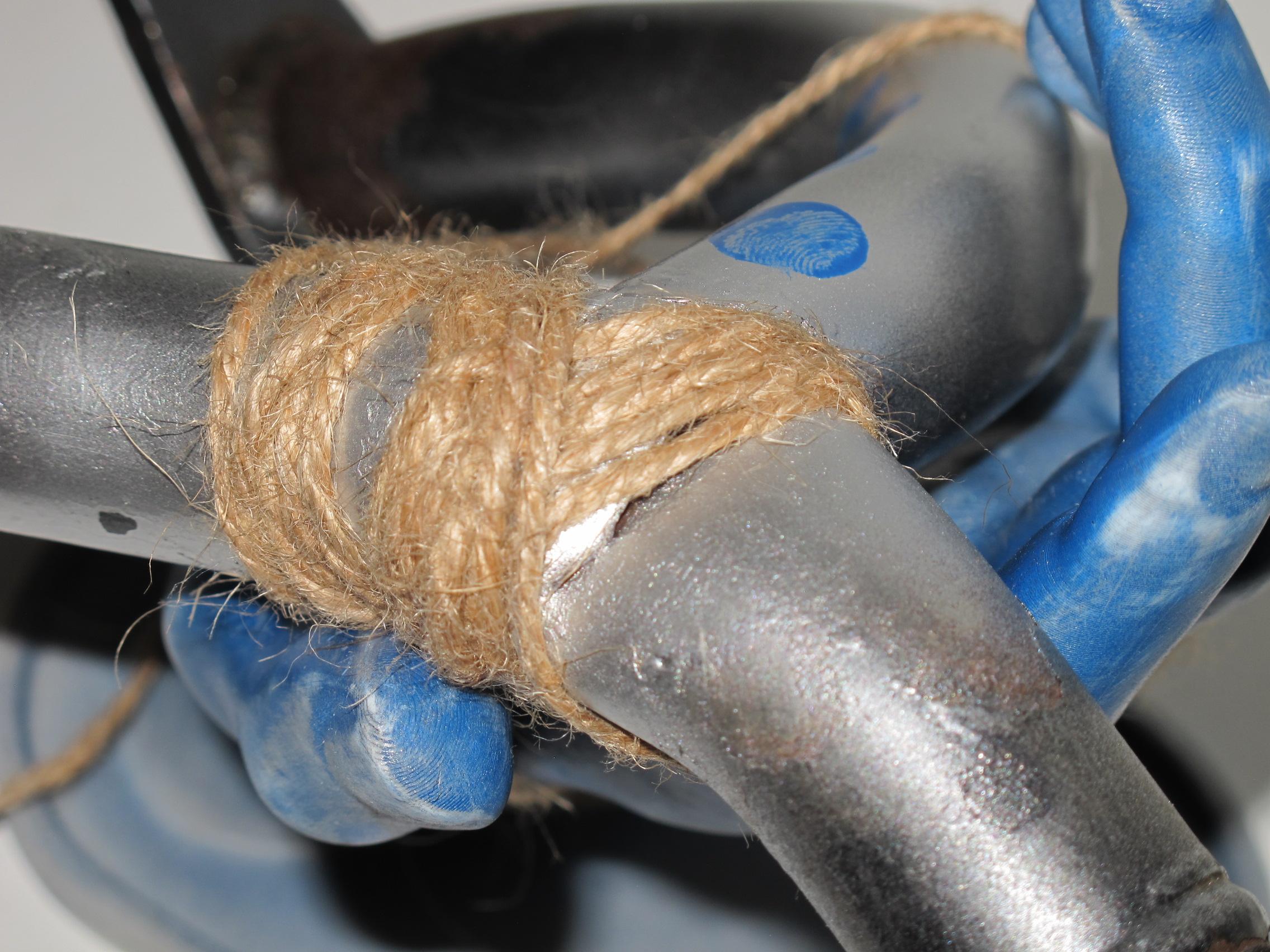
twine, unknotted, bound loosely 03
I chose twine for its softness and left its end loose before I knew why. A binding that could easily come undone makes staying tied a choice.
A crash bar is made to be sacrificed. It takes the damage so the bike and rider don’t. When I crashed my motorcycle in my first week with it, mine took the hit. I didn’t replace the bike, and I kept the bar. Both had looked after me, and it felt wrong not to look after them in return.
Simon Sinek (2009) states that we should start with why. That became mine: the things we own should serve us as much as we serve them. Many products only work one way: they serve us until they fail, and we cannot serve them back. When the unserviceable, unrecyclable, unrepairable glued-in batteries of Apple’s AirPods Pro 3 eventually die, owners can’t replace them, rendering the earbuds “essentially disposable” (Chamberlain, 2025). Packard (1960) warned of products made to wear out so that we buy them again. The answer is to own less and know it well. For designers it is to make things worth knowing.
A knife, a jacket or a pair of boots becomes ours through use. We learn its weight, its feel and its quirks, exactly as it learns us: boots mould to our feet, a handle wears to our grip, and a jacket essentially becomes part of our identity. We then feel responsible for it and view it as an extension of ourselves. Chapman (2005) argues that what has to last is the relationship, not just the object. Crawford (2009) warns that things we no longer understand make us passive and dependent. Yet understanding is not seeing inside: a good watch hides its workings behind the dial, yet people wear one for decades and pass it on.
In my sculpture, a blue hand holds the bent bar up by its fingertips, serving the thing that once served its rider. Twine binds the two loosely. Held up, held together, held responsible. Only afterwards did I see that a binding which could easily come undone made staying tied a choice. Sennett (2008) argues that making is thinking; here I felt that my hands found the idea first.
As a designer, I am bound to my work in the same way, responsible for how it ages and ends. That means things that can be learned by feel, that wear in and not out. I want to design things people can hold on to, and stay tied to them long after they leave my hands.
references
Chamberlain, E. (2025) ‘AirPods Pro 3 teardown: still a tragedy’, iFixit, 1 October. Available at: https://www.ifixit.com/News/113507/airpods-pro-3-teardown-still-a-tragedy (Accessed: 17 October 2026).
Chapman, J. (2005) Emotionally durable design: objects, experiences and empathy. London: Earthscan.
Crawford, M.B. (2009) Shop class as soulcraft: an inquiry into the value of work. New York: Penguin Press.
Packard, V. (1960) The waste makers. New York: David McKay.
Sennett, R. (2008) The craftsman. London: Allen Lane.
Sinek, S. (2009) How great leaders inspire action [video]. TED. Available at: https://www.ted.com/talks/simon_sinek_how_great_leaders_inspire_action (Accessed: 17 October 2026).